BLACK FRIDAY IS HERE! ✦ 20% OFF EVERYTHING · Shop the Sale →
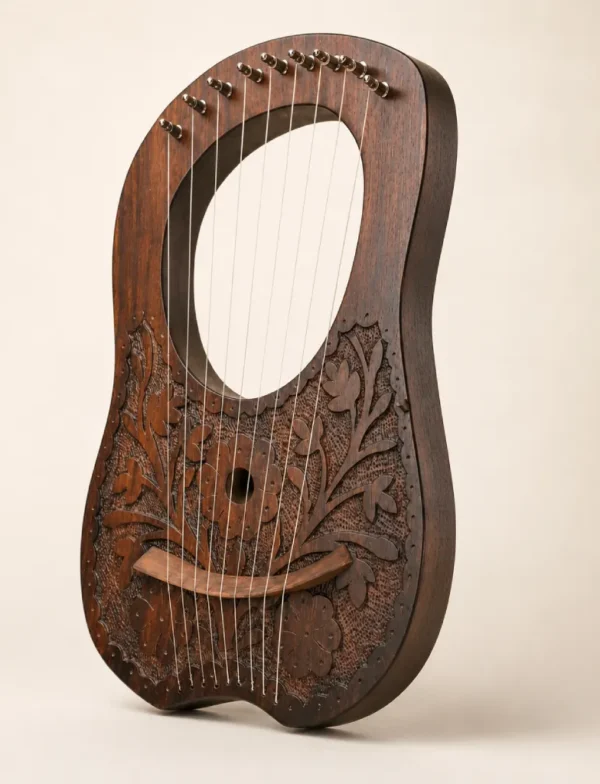
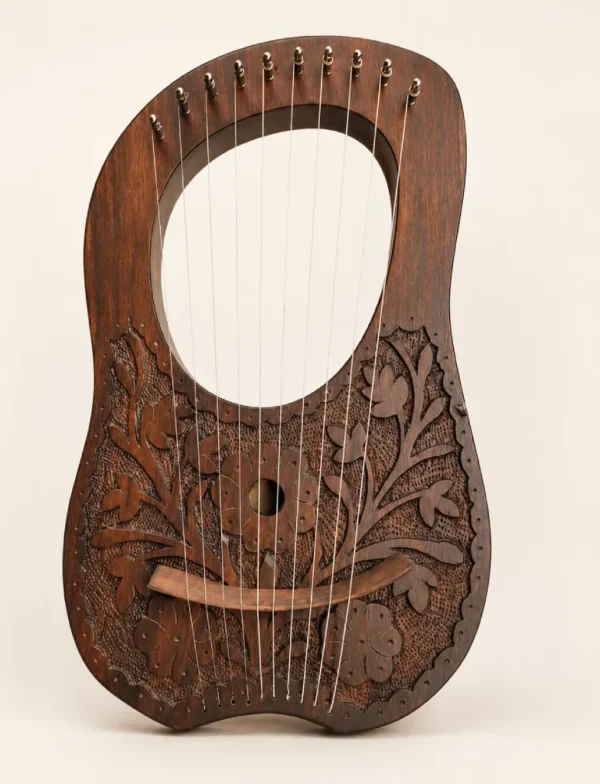
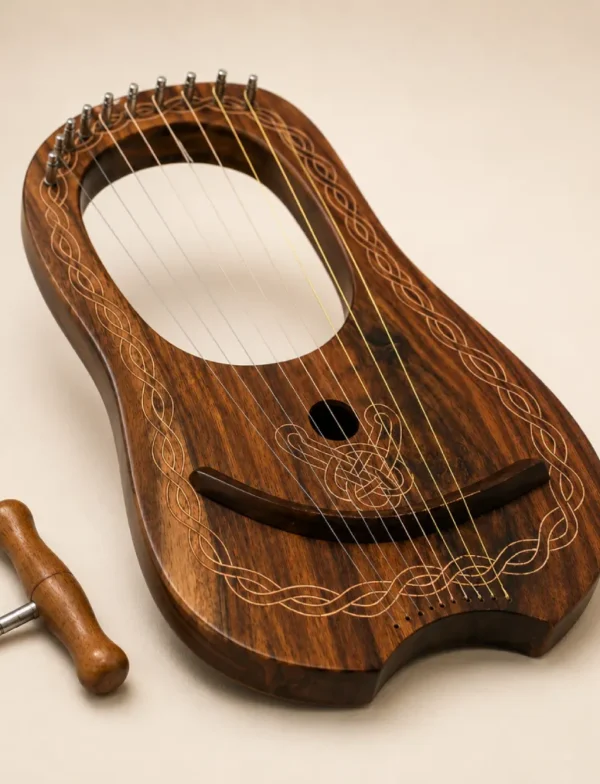
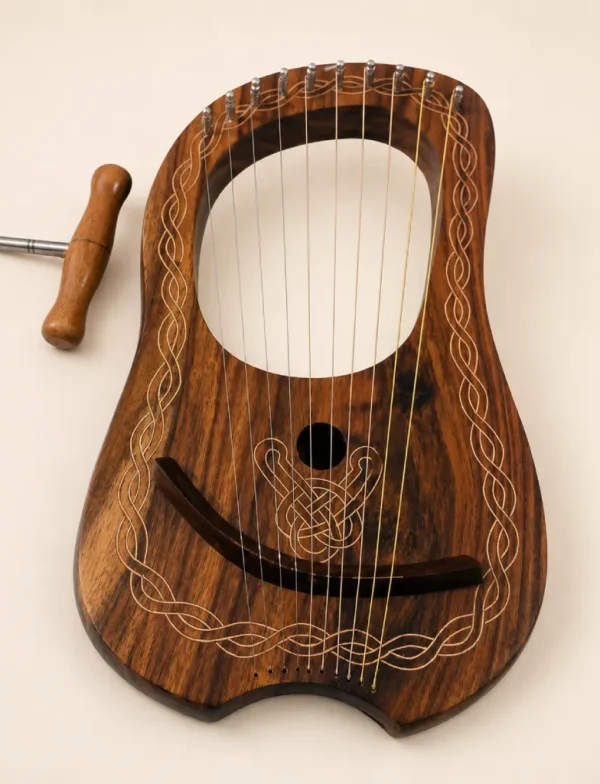
About our lyre harps
Lyre harps from beginner to performance, supplied since 2017
Kilt and Jacks has been supplying lyre harps to musicians and buyers of the tradition since 2017. Every lyre we ship — whether a small 7-string starter lyre for a complete beginner, a 10-string mid-range instrument for a developing player, or a 16-string or 22-string full-range lyre for serious performance and composition — is quality-checked at our workshop before dispatch, tuned before shipping, and backed by our replacement guarantee. We supply lyre harp players worldwide, from complete beginners picking up the instrument through mythology or meditation communities, through folk revivalists exploring the modern lyre tradition, through composers and performers using the instrument in contemporary contexts.
The range is built around the four string configurations that map to the lyre player's development: 7-string lyres — the smallest, most accessible starting instrument, suited to complete beginners and travel playing; 10-string lyres — the developing player's instrument, wider range for melodic playing without the price and size of a full lyre; 16-string lyres — the performance and composition instrument, with enough range for two-hand playing and complex arrangement; and 19 to 22-string lyres — the serious performance and full-range instruments for players committed to the instrument long-term.
The lyre harp tradition — ancient origin, modern revival
The lyre is one of the oldest stringed instruments in human musical history. Ancient Greek civilisation gave us the images and mythology we associate with the instrument today — Apollo the god of music playing the lyre, Orpheus charming beasts and moving stones with his playing, countless depictions of lyres across classical Greek art and literature. Before Greek civilisation, lyres existed across Middle Eastern and Mediterranean cultures — Sumerian lyres from thousands of years BCE remain among the oldest musical instruments ever recovered by archaeology. The instrument is genuinely ancient, genuinely tied to the classical civilisations that shaped Western culture, and genuinely part of the mythology that has captured contemporary imagination.
The modern lyre revival is equally real. Since roughly 2020, the instrument has experienced a genuine global resurgence — driven partly by TikTok communities sharing lyre playing and lyre-based compositions, partly by mythology-adjacent contemporary literature (Percy Jackson series, Madeline Miller's Song of Achilles and Circe, general classical mythology aesthetic in Gen Z and millennial culture), partly by meditation and therapeutic music communities embracing the instrument for its calming resonance, and partly by folk revivalists exploring the lyre as a portable and accessible alternative to Celtic and full concert harps. The community is global, diverse, and growing, with active online communities on TikTok, Instagram, YouTube, and Reddit sharing tunes, techniques, and recommendations.
Both the ancient tradition and the modern revival are legitimate reasons to play the lyre. Buyers coming to the instrument through Greek mythology aren't playing a costume — they're picking up an instrument with a genuine three-thousand-year history. Buyers coming through TikTok aren't riding a trend — they're joining a real modern community with serious players and legitimate musical output. Both paths are honest paths into the instrument.
Choosing your string count
The most consequential choice when buying a lyre harp is the string count. It determines your playing range, your instrument size and portability, your price point, and the type of music you can play. Here's the honest guide.
7-string lyres are the ancient traditional configuration — the classical Greek lyre had 7 strings, and modern 7-string lyres are the closest to the historical instrument. They're small, extremely portable (some are pocket-sized), inexpensive, and accessible to complete beginners. The seven-string range is genuinely limited for modern melodic playing — you can play simple melodies and chord progressions, but complex tunes with wider melodic range require string retuning mid-piece. Best suited to: complete beginners exploring the instrument, meditation and ambient playing where limited range isn't a constraint, historical reproduction context, and buyers wanting the most affordable entry point.
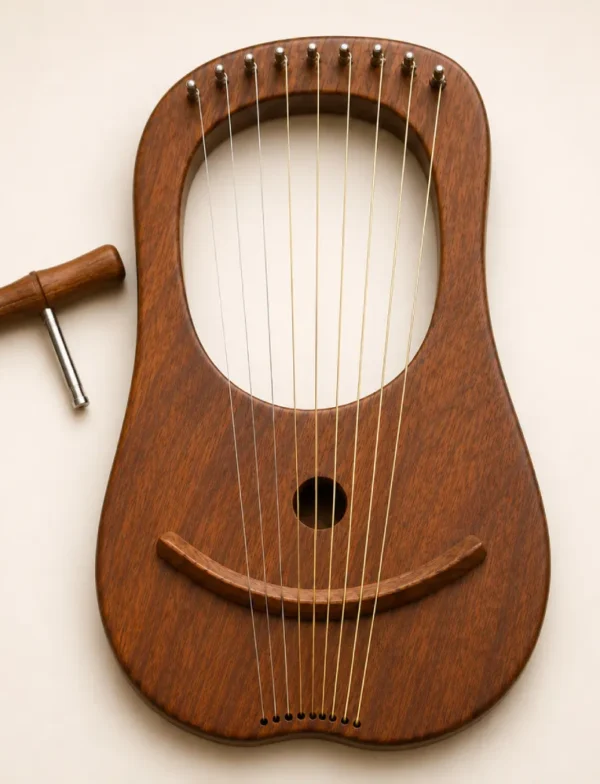
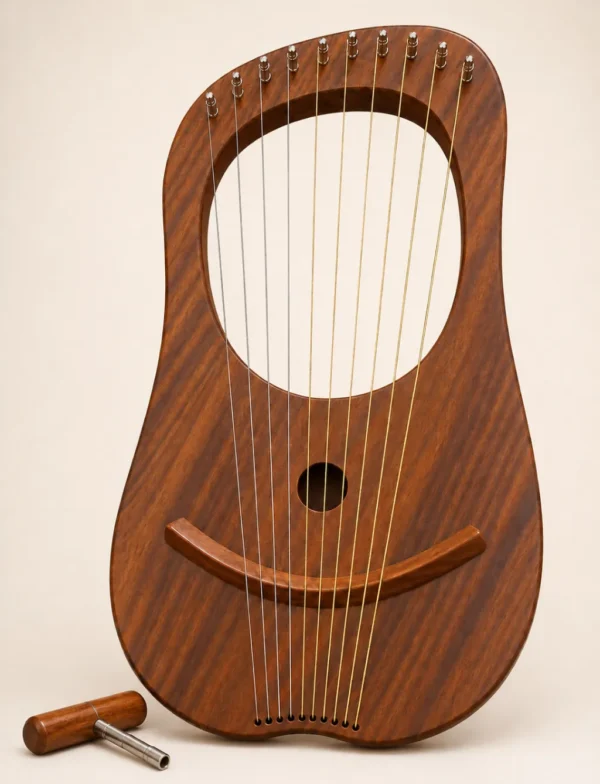
10-string lyres are the honest first serious instrument for most modern lyre players. Ten strings provides enough range to play the majority of folk and simple traditional tunes without retuning, remains portable and affordable, and offers a genuinely better playing experience than 7-string models for anyone who plans to play actual tunes rather than just meditative resonance. Best suited to: buyers past the complete-beginner exploration stage, folk revival and meditative playing where broader range matters, and anyone who wants a serious first instrument they'll play for years rather than outgrow in months.
16-string lyres are the performance and composition instrument. Sixteen strings offers full melodic range, two-hand playing capability (accompaniment in one hand, melody in the other), and enough tonal breadth for composition and arrangement. This is the range where lyre playing becomes genuinely comparable to entry-level Celtic harp in musical expressiveness, at a fraction of the cost. Best suited to: serious lyre players who've moved past 10-string, composers using the lyre in modern contexts, performers using lyre in ensemble or recording settings, and buyers ready to commit to the instrument long-term.
19 to 22-string lyres are the full-range serious instruments. This is the top of the modern lyre range, offering nearly complete melodic range across two octaves and full compositional capability. Larger, heavier, and more expensive than the smaller configurations, but the instrument this becomes is genuinely a serious musical tool rather than a beginner instrument. Best suited to: professional and semi-professional lyre players, composers and performers whose musical demands exceed 16-string range, and long-term players building a serious instrument.
Not sure which string count to start with? For most complete beginners, we honestly recommend starting with a 10-string lyre rather than the 7-string starter — the 10-string is only marginally more expensive, offers significantly more musical range, and gives you an instrument you won't quickly outgrow. The 7-string is right if budget is the primary constraint or if you specifically want the historically authentic 7-string configuration. Beyond that, upgrade to 16-string when you're playing tunes that push against the 10-string's range, and to 22-string only if you're seriously committed to the instrument long-term.
Solid body vs hollow body construction
Beyond string count, the second major choice is body construction. Both are legitimate — the choice depends on tonal preference and playing context.
Hollow body lyres have a resonant hollow chamber that amplifies the string vibrations, producing a louder, richer, more sustained tone. The hollow body is closer to the traditional lyre construction and reads more musically serious. It's the choice for buyers who want acoustic projection (playing without amplification for others to hear), fuller tonal complexity, and the classical lyre sound. Slightly more expensive than solid body, and slightly less durable in travel due to the hollow construction.
Solid body lyres are cut from a single piece of wood without a resonant chamber. The tone is quieter and more direct — closer to a stringed instrument played close to the ear than a projecting acoustic instrument. Solid body lyres are more travel-friendly (nothing to damage in the resonant chamber), often cheaper, and produce a distinct meditative sound that many players actually prefer for personal playing and meditative contexts. If you want a lyre primarily for your own playing, meditation, or ASMR-style intimate recording, solid body is honestly the better choice for many buyers.
Wood options across both constructions typically include mahogany (warm, traditional), rosewood (bright, resonant), maple (light, clear), and walnut (dark, mellow). Wood choice affects tone subtly rather than dramatically at the lyre scale — for most buyers, string count and body construction matter more than specific wood species.
What comes with a lyre harp
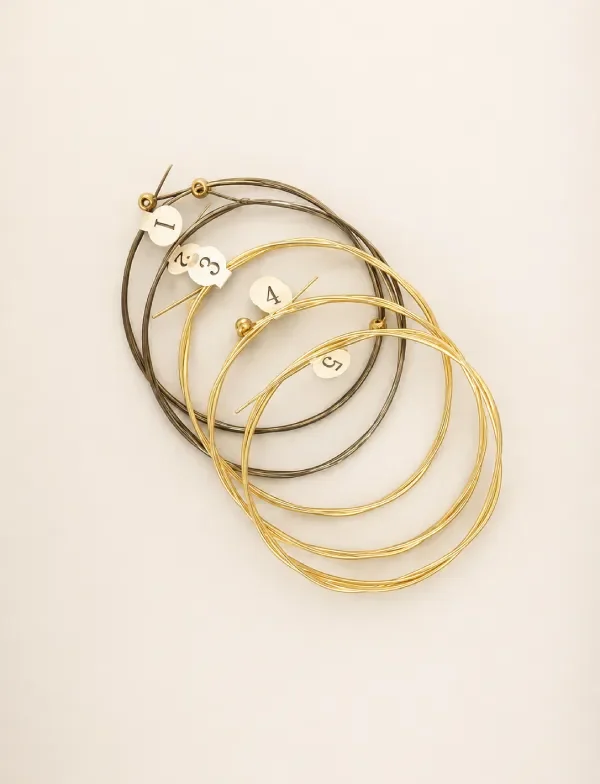
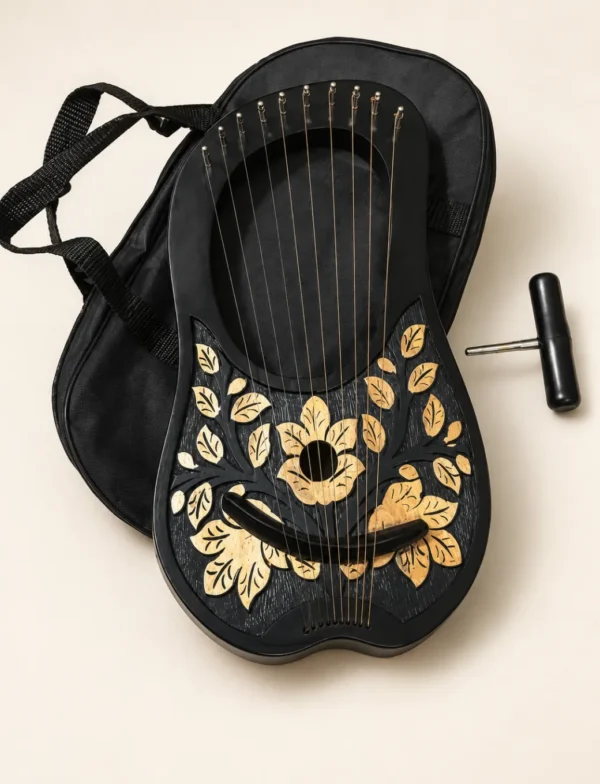
Every lyre in the range ships with the tuning key required to tune the instrument (lyres are tuned with a small wrench-like tool that turns the tuning pegs), a padded case for transport and storage, spare strings (typically one or two full spare sets depending on the model), and a beginner's tuning and playing guide covering basic instrument care, tuning to standard tunings, and simple starter melodies. Some higher-range models also include recorded tuning references and access to online tutorial content. Complete beginners can pick up a lyre from our range and be playing simple melodies within the first week without any additional purchases.
Learning the lyre — resources and community
The lyre has one of the most accessible learning curves of any stringed instrument. Basic melody playing on a 7 or 10-string lyre can be self-taught from YouTube and TikTok tutorials — the online lyre community is remarkably active and welcoming to beginners, with countless free tutorials on tuning, basic melodies, popular songs adapted for lyre, and folk and mythology-adjacent repertoire. For more serious playing, particularly on 16-string and larger instruments, working with a teacher accelerates learning meaningfully. The global online community includes qualified lyre teachers offering online lessons via Zoom and other platforms, and the community forums on Reddit (r/lyre) and Discord servers offer active peer learning and recommendations.
For repertoire, most lyre players start with simple folk melodies, popular songs adapted to the lyre's range, and traditional Greek and Mediterranean melodies. As range expands with larger lyres, players expand into Celtic harp repertoire adapted for lyre, meditative and ambient compositions, and increasingly original modern compositions from the growing lyre-composer community. There's no shortage of playable music for the instrument at every skill level.
Every lyre harp ships in ten working days, is quality-checked and tuned before dispatch, and comes with our replacement guarantee for manufacturing defects. See our returns policy for full terms. Lyre harps pair naturally with the broader folk and Celtic music instruments range — many lyre players also pick up tin whistles for melodic playing, and the two instruments together cover most of the folk-revival repertoire buyers explore. For Celtic tradition-specific harp playing, see our Celtic harps range with clàrsach in traditional Gaelic tradition.
4 configurations7, 10, 16,
and 22-string
and 22-string
10 daysQuality-checked,
tuned, shipped
tuned, shipped
Everything includedTuning key, case,
spare strings, guide
spare strings, guide
Replacement guaranteeOn manufacturing
defects
defects
Frequently asked
Questions before ordering
How many strings should a beginner lyre harp have?
For most complete beginners, we honestly recommend starting with a 10-string lyre rather than a 7-string starter. The 10-string is only marginally more expensive, offers significantly more musical range for playing actual tunes, and gives you an instrument you won't quickly outgrow. The 7-string is the honest choice if budget is the primary constraint (7-string lyres are the most affordable), if you specifically want the historically authentic ancient Greek 7-string configuration, or if you're buying purely for meditative and ambient playing where limited range isn't a constraint. Most modern players find that once they can play simple melodies, the 7-string's limited range becomes frustrating within a few months and they upgrade to 10 or 16-string anyway. Starting at 10-string skips that intermediate purchase for most buyers.
What's the difference between a lyre harp and a regular harp?
Historical origin and physical construction. Lyre harps have their strings arranged in a single plane across a yoke supported by two arms extending from a resonant body — the ancient Greek and Middle Eastern construction. Lyres are typically small (7 to 22 strings), portable, and played held against the body or in the lap. Regular harps (concert harps, pedal harps, Celtic harps, lever harps) have strings arranged in a triangular frame with the strings running from the neck of the harp down to a sound box at the bottom. Regular harps are larger, more expensive, and require standing or sitting at a fixed position to play. Both are stringed instruments, both are ancient, and both are legitimate paths into harp playing — but the physical instruments and playing techniques are genuinely different. Lyre harps are dramatically more accessible and affordable than concert or Celtic harps, which is part of why the modern lyre revival has grown so quickly.
Can I learn lyre harp with no musical background?
Yes — and the lyre is genuinely one of the most accessible instruments for complete beginners with no prior musical background. Most new players can tune the instrument and play simple melodies within the first week. Playing recognisable folk songs and adapted pop songs comes within the first month for most learners practising consistently. The lyre doesn't require reading traditional sheet music (though you can if you want to) — most modern lyre learning uses letter-notation tabs or visual finger-position guides that are genuinely beginner-friendly. The online lyre community on TikTok, YouTube, and Instagram is remarkably welcoming and produces countless free tutorials aimed at complete beginners. You don't need any prior instrument experience, and you don't need to be able to read music. If you can follow simple visual instructions, you can play the lyre.
Are lyre harps really the instrument from Greek mythology?
Yes — the lyre is genuinely the instrument depicted throughout ancient Greek mythology and art. Apollo the god of music is traditionally shown playing the lyre. Orpheus, the mythological musician whose playing could charm beasts and move stones, plays the lyre. Countless other figures across Greek mythology and Homeric epic are associated with the instrument. Ancient Greek civilisation used the lyre as a serious musical instrument in poetry recitation, religious ceremony, and formal musical performance. Modern lyre harps are new instruments built in the historical lyre tradition — not archaeological reproductions of ancient instruments, but contemporary constructions that carry the same basic form, playing style, and musical spirit. When you play a modern lyre, you're playing an instrument in a continuous three-thousand-year tradition that includes the mythological figures who defined Western musical imagination.
Solid body or hollow body — which should I choose?
Both are legitimate — the choice depends on how you plan to play. Hollow body lyres have a resonant hollow chamber that amplifies the strings, producing a louder, richer, more sustained tone with acoustic projection. Choose hollow body if you want your lyre to project sound to others (playing for family, small performance, ensemble), if you want the fuller traditional lyre sound, and if you're less concerned about travel durability. Solid body lyres are cut from single pieces of wood without resonance chambers, producing a quieter, more direct, more intimate tone. Choose solid body if you're playing primarily for yourself (meditation, personal playing, ASMR-style intimate recording), if you travel with the instrument frequently, or if you specifically prefer the meditative solid-body sound. Neither is objectively better — many serious lyre players own both for different contexts.
How do you tune a lyre harp?
Lyres are tuned with a tuning key — a small wrench-like tool that fits over the tuning pegs at the top of the instrument. Each string wraps around its own tuning peg, and turning the peg with the tuning key tightens or loosens the string to raise or lower its pitch. Most lyres come tuned to a specific starting configuration (typically C major or D major for 7 and 10-string lyres; wider modal ranges for larger instruments), and you tune to this standard by ear or using a tuning app on your phone (many free options — GuitarTuna, Fender Tune, and dedicated lyre tuning apps are widely used). Tuning takes 2-5 minutes for a full lyre once you're familiar with the process. New strings stretch over the first few days of playing and need frequent retuning until they settle — after the first week of playing, most lyres hold tune for days at a time with only minor adjustments. Every lyre we ship includes the tuning key required for the instrument and a tuning guide covering the standard configurations.
How long do lyre harp strings last and how do I replace them?
Lyre strings typically last 1-3 years depending on playing frequency, environmental conditions, and string material. Signs that a string needs replacing include difficulty holding tune, dulled or dead tone, visible corrosion or wear at the peg or bridge contact points, and (obviously) breakage. Replacing a lyre string is genuinely simple — remove the old string from the peg and bridge, thread the new string through the peg hole and around the peg following the standard winding pattern, tune to pitch, and let it stretch and settle over the next few days of playing. Every lyre in our range ships with at least one full spare set of strings, and additional strings are available through our harp strings and accessories section. Most players replace strings individually as they wear or break rather than doing full re-stringings — a full re-string is only necessary when the entire set is aged, corroded, or the tone across the instrument has dulled.
Do you sell lyre harps that are actually authentic to Ancient Greek tradition?
The modern lyres in our range are contemporary instruments built in the ancient lyre tradition — they follow the basic form (yoke supported by two arms, strings arranged in a single plane, played held against the body or in the lap) and playing style of the ancient Greek lyre, but they're new instruments made by modern makers using contemporary construction techniques and materials. They are not archaeological reproductions of specific ancient instruments. For genuinely reconstructed ancient Greek lyres — instruments built to match specific archaeological finds like the Elgin lyre in the British Museum or the Petrie lyre from the Egyptian Museum — you would need to commission a specialist maker of ancient instrument reproductions, which is a specialised and expensive market outside our range. Our lyres serve players who want to play in the lyre tradition using modern accessible instruments, not scholars building museum-grade reproductions.
Can I use a lyre harp for meditation and therapeutic music?
Yes — lyre harps are increasingly one of the most popular instruments for meditation, therapeutic music, sound bath practice, and general contemplative playing. The instrument's tone is naturally calming, sustained, and resonant, and the accessible learning curve means practitioners can develop meaningful playing capability without years of prior musical training. For meditation and therapeutic contexts, solid body lyres are often preferred over hollow body for their more intimate, direct tone. 7-string or 10-string lyres are typically sufficient for meditative playing (range constraints matter less when you're playing sustained chord progressions and ambient patterns rather than complex melodies). The lyre also travels well to yoga studios, retreat centres, and clinical therapeutic settings, and it's increasingly used by music therapists working with clients across ages and contexts.